
Transmitter presents:

ANAHITA

AMY ROSE KHOSHBIN
OCTOBER 3 – NOVEMBER 2, 2026
OPENING RECEPTION:
 SATURDAY, OCTOBER 3, 6 - 8 pm
PERFORMANCE: OCTOBER 17
COLLAGE WORKSHOP: OCTOBER 25
CLOSING PERFORMANCE: SUNDAY, NOVEMBER 2, 3 pm

Transmitter is pleased to present ANAHITA, a solo exhibition and participatory installation by Iranian-American artist Amy Rose Khoshbin, curated by Lila Nazemian. Drawing from Anahita, the ancient Persian goddess associated with water, healing, fertility, and wisdom, Khoshbin transforms the gallery into a contemporary sanctuary for collective grief, ritual, and release.

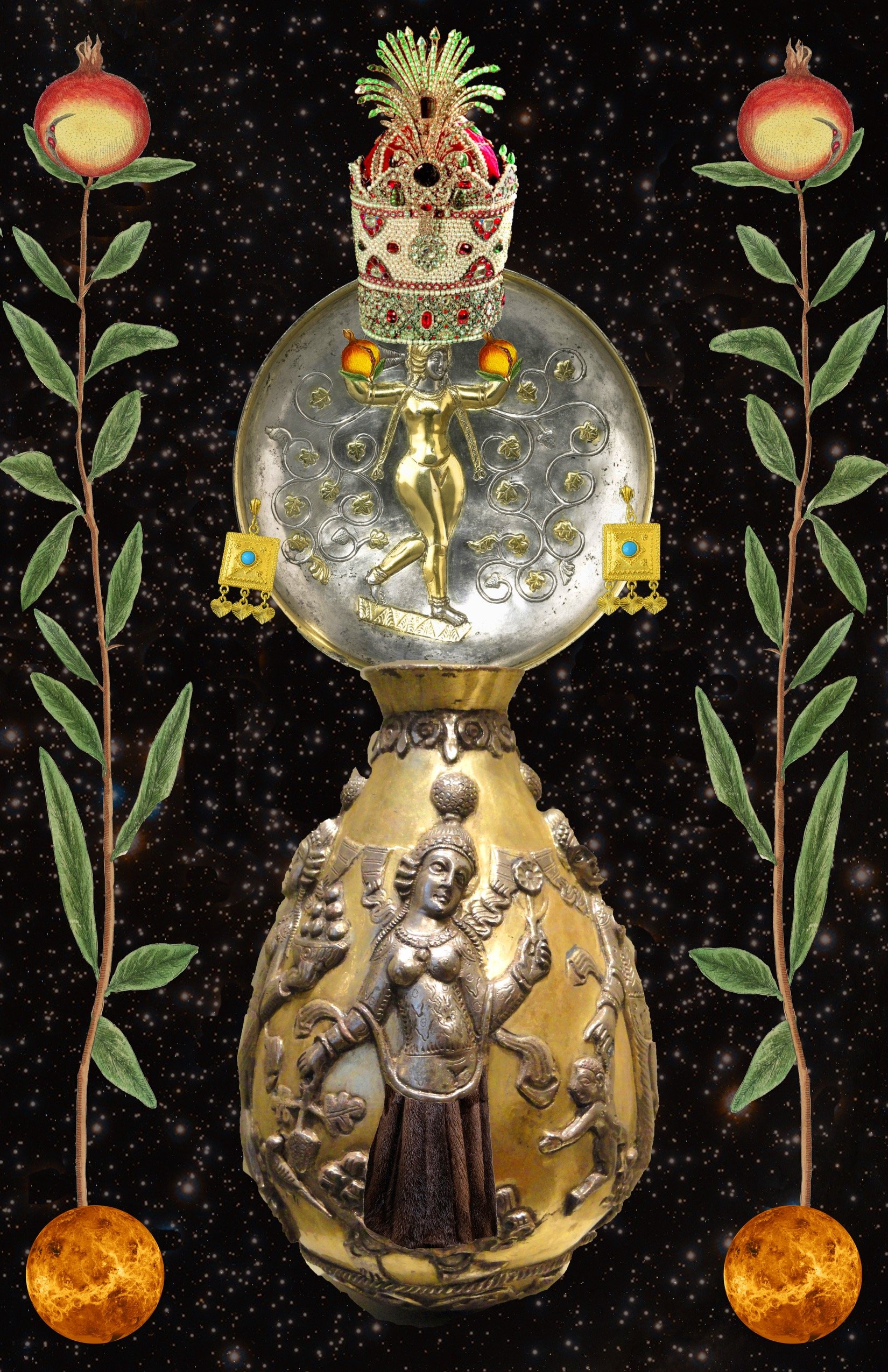
Meteor, Collage, 17 x 11 in

The exhibition takes on particular urgency amid the protracted war involving Iran, where Iranian bodies and lives are encountered primarily through images of conflict. ANAHITA turns toward Persian cosmology, ritual, and material culture as living forms of knowledge. The exhibition asks what inherited ceremonial practices might offer in a present shaped by displacement, militarization, ecological collapse, illness, and grief.

At the center of the exhibition is a large modular grief tent informed by Persian ceremonial and funerary architecture, processional structures, palanquins, and coffins. Suspended at the intersection of shrine, sanctuary, and procession object, the tent functions as both sculpture and performance space. Conceived for anyone carrying something during wartime, it welcomes personal, ancestral, political, ecological, and collective grief, including forms of loss that resist public recognition or language. Throughout the exhibition, it becomes a site for rest, oracle readings, intimate rituals, and participatory performances.

Part of the tent's textile covering transforms into a ceremonial robe worn by Khoshbin during performance. Rather than embodying the goddess, Khoshbin uses the garment to channel ANAHITA, transforming the body and architecture together into instruments for ritual and collective release.

Water operates as the exhibition's central metaphor. Grief, fear, illness, trauma, and inherited violence are imagined as forces that can become lodged in the body, interrupting its natural currents. Rather than attempting to erase these experiences, ANAHITA asks how they might be transformed through attention, ritual, and communal witnessing.

This process takes physical form through CYST-Ms, soft silicone sculptures that materialize what accumulates in bodies living within oppressive systems. Visitors may meet with Khoshbin one-on-one to create a personalized CYST-M around a grief, fear, illness, memory, or transformation. Participants may then activate their sculpture through private or collective ritual. When ceremonially cut open, the sculptures release their viscous contents, transforming blockage into movement. As CYST-Ms accumulate throughout the exhibition, they form an evolving collective record of what visitors have been carrying.

Surrounding the tent is a constellation of ritual objects: ANAHITA'S KNIFE, a khanjar-inspired ceremonial blade; a sculptural Persian daf drum activated through sound and performance; a ceramic fountain created collaboratively with Khoshbin's mother; and ANAHITA'S ORACLE, a thirty-three-card divination system developed through an ongoing collage practice.

The original oracle collages are installed throughout the gallery as both autonomous artworks and fragments of an evolving cosmology. Drawing from Zoroastrian symbolism while inventing new visual languages, the deck imagines Anahita's four horses, Wind, Rain, Sleet, and Storm, alongside bodies, ancestors, technologies, landscapes, and contemporary rituals. Rather than reconstructing a fixed mythology, Khoshbin proposes a cosmology that remains open to invention, participation, and change.

The exhibition evolves throughout its run as visitors activate its objects and contribute to its rituals. On October 17, Khoshbin will activate the installation through a public participatory performance centered on collective release. On October 25, visitors are invited to a collective collage-making session to collaboratively create one of the original works for ANAHITA'S ORACLE.

Together, the tent, robe, oracle, fountain, knife, drum, collages, and CYST-Ms form an interconnected ritual system in which sculpture, installation, performance, mythology, and collective practices of care become inseparable. Rather than illustrating an ancient deity, ANAHITA asks what it might mean to build a living cosmology for the present, one that treats grief as water seeking movement, ritual as collective technology, and art as a place where healing can be rehearsed together.

ARTIST BIO: 

Amy Rose Khoshbin is an Iranian-American artist based in New York and Los Angeles. Working across installation, performance, social practice, sculpture, video, and collage, she builds participatory worlds where sensory experience becomes a path toward liberatory futures. Her work has been presented at the Whitney Museum, the Guggenheim Museum, the Brooklyn Museum, Times Square Arts, Crystal Bridges, Artpace, the High Line, and festivals including SXSW and River to River. Residencies include the Watermill Center, LMCC, Anderson Ranch, Project for Empty Space, and the Banff Centre, and received awards from NYFA, Franklin Furnace, and Rema Hort Mann. Khoshbin holds an MFA from NYU. She has collaborated with Laurie Anderson, Karen Finley, Anne Carson, and more.
@tinyscissors